

In the previous article "Why Should Steelmakers Prioritize Cored Wire Selection for Efficient and High-Quality Production?"(https://www.weidamaterials.com/show-18-1244.html), we discussed the importance of cored wire selection for efficient and high-quality production in steelmaking. This article shifts focus to the foundry sector, providing an in-depth analysis of the key technical specifications and core performance of cored wire, as well as their profound impact on final casting quality. We will also examine the advantages and disadvantages of different core material preparation methods, aiming to provide a clear pathway for foundries to address practical production challenges and enhance the competitiveness of their castings.
Core Technical Specifications: The "Lifeline" of Casting Quality
The performance of cored wire is not determined solely by the composition of its core material. A series of key technical specifications collectively form the foundation of its quality, directly affecting the stability of the treatment process and the final quality of the castings.
Chemical composition stability is fundamental. The content of key elements such as magnesium (Mg) and rare earth (Re) in the core material must be precise with minimal fluctuation. Unstable chemical composition is a direct cause of fluctuating nodularity grades and inconsistent mechanical properties in castings. Wuxi WeiDa Cored Wire Co., Ltd. understands this critical point. Through precise formulation and stringent process control, we ensure highly consistent composition in every batch of core material. This provides a fundamental guarantee for the stability and reliability of casting quality, effectively avoiding the risk of batch scrap due to composition variations.
Magnesium oxide (MgO) content is a key control parameter. Excessively high MgO content not only increases costs but also significantly raises the risk of slag inclusion defects in castings, leading to deterioration of nodularization effectiveness and graphite morphology. We treat this as a core monitoring indicator, ensuring the MgO content in our core material is strictly maintained below 5.0% of the total magnesium content. This helps our customers reduce slag inclusions, improve nodularity rates, and lower cleaning costs.
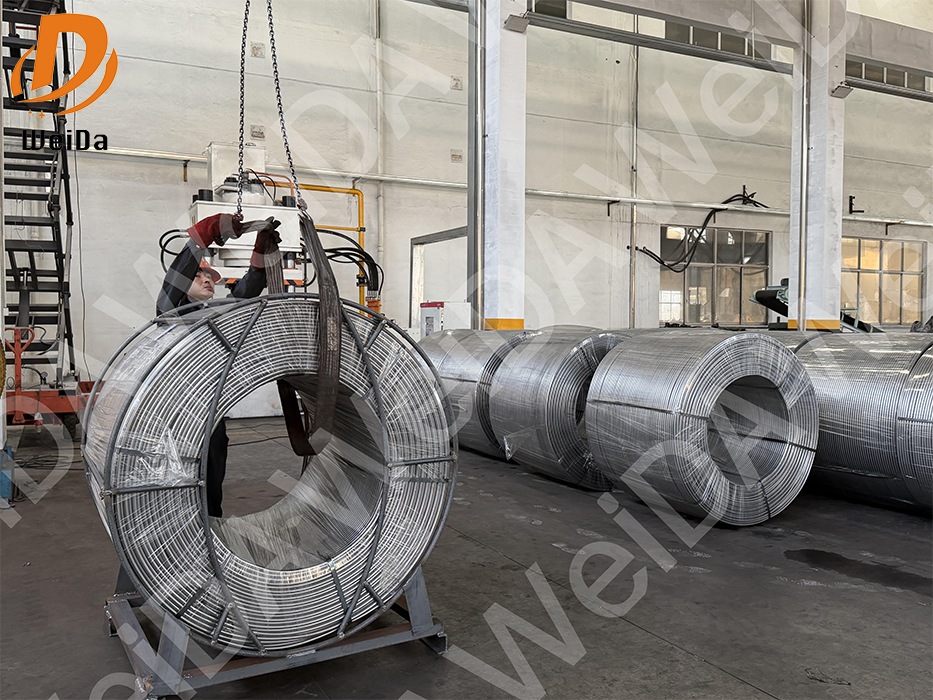
Physical specifications and appearance ensure process stability. The particle size distribution of the core material (typically controlled within 0.1-2.5mm), dryness (moisture ≤ 0.3%), and the physical appearance of the cored wire itself (no hollow wrapping, powder leakage, or rust) directly influence the smoothness of the wire feeding process and the dissolution behavior of the core material in the molten iron. Uniform filling and robust steel strip (tensile strength ≥ 275 MPa) can effectively prevent wire breakage and blockage during feeding, ensuring a precise and repeatable treatment process. This is a prerequisite for achieving automated and intelligent wire injection treatment.
Core Material Preparation Methods: Choosing the Right Path for Your Process
The preparation process of the core material determines its internal uniformity and application characteristics. Currently, there are three main methods, each suited for different scenarios.
Core material produced by the Fusion Method exhibits high compositional uniformity. Magnesium exists in the form of a master alloy, leading to more stable absorption and consistent nodularizing effects. It is particularly suitable for producing high-grade ductile iron castings. However, its production process is energy-intensive, involves safety risks, and carries a relatively higher cost.
The Mechanical Mixing Method offers lower costs and avoids melting losses. However, due to differences in the proportions and particle sizes of the components, ensuring mixing uniformity is challenging. This can lead to fluctuations in the composition per unit length of wire, potentially affecting the uniformity of casting quality in mass production. This presents a potential challenge for customers pursuing high-end, stable quality.
The Layered Stacking Method, as an improved process, attempts to enhance uniformity through layered distribution of materials. However, its long-term stability and consistency still require extensive production validation.
Addressing the limitations of different methods, Wuxi WeiDa Cored Wire Co., Ltd. combines advanced processes with strict quality control, committed to providing customers with cored wire products that offer more uniform composition, more controllable reactions, and better cost-effectiveness. We help customers tackle the challenge of quality consistency while controlling costs.
Process Optimization: Transforming Premium Materials into Premium Castings
Having high-quality cored wire is only the first step; scientific wire feeding processes are equally crucial. Among these, the height-to-diameter ratio of the treatment ladle (recommended 1.1~1.2) is a core process parameter. An improper ratio directly leads to reduced magnesium absorption, violent reactions, or insufficient treatment. Our technical team can provide customers with targeted process debugging services to determine the optimal wire feeding speed and insertion angle.
Furthermore, treatment temperature control, ladle cover sealing, effective fume extraction design (recommended side or top extraction to avoid excessive cooling), and stability of the wire feeding equipment collectively constitute a successful wire injection treatment system. Especially when producing large, heavy-section castings, multi-wire feeding, composite inoculation (such as stream inoculation, in-mold inoculation), and targeted core material formulation (e.g., adjusting rare earth content, adding elements like Ca, Ba) may be necessary to address issues like graphite degeneration caused by long solidification times. This is precisely the kind of in-depth process support we can provide to our customers.
Conclusion: Empowering Foundries for High-Quality Development with Stable and Reliable Cored Wire Technology
Competitiveness in the foundry industry is increasingly reflected in comprehensive dimensions such as quality stability, production cost control, and production environment improvement. Selecting cored wire that is precisely formulated, meets strict specifications, and is consistently supplied, combined with optimized wire feeding processes, is an effective way to address a series of issues including unstable nodularization, excessive slag defects, poor working environments, and high scrap rates.
Wuxi WeiDa Cored Wire Co., Ltd., as a professional provider of cored wire solutions, not only supplies high-quality nodularizing, vermiculizing, and inoculating cored wires but is also committed to being a process partner for our customers. Through our products and services, we help customers achieve goals such as minimal molten iron temperature drop during treatment, excellent and stable nodularization effects, a clean workshop environment, and a high degree of production process automation, ultimately enhancing the competitiveness of their castings in high-end markets.
To learn more about how to improve your casting quality by optimizing cored wire technology and wire feeding processes, please visit our official website at https://www.weidamaterials.com/ for professional solutions.