

Following our discussion on calcium treatment challenges for high-sulfur steels, we turn to a major cost item in ladle metallurgy: refractory material consumption. The ladle serves as the "transport and refining vessel" for molten steel from the primary furnace to the continuous caster. Its refractory lining withstands severe conditions: high temperatures, steel, slag corrosion, and thermal cycling. High refractory consumption not only directly increases production costs but also brings risks of steel re-carburization, re-oxidation, and inclusion pickup, affecting steel cleanliness. How can you effectively reduce refractory consumption in steel ladles, extend ladle life, and achieve efficient turnover of "one ladle for multiple heats"? Wuxi WeiDa Cored Wire Co.,Ltd provides solutions for ladle refractory protection based on slag system optimization and magnesia cored wire technology.
The Root Causes of Refractory Consumption: Chemical Attack and Thermo-Mechanical Stress
The damage to ladle refractories primarily occurs through three mechanisms: First, chemical attack. FeO, MnO, CaO, and SiO₂ in the refining slag react with MgO and Al₂O₃ in the refractory, forming low-melting-point phases that cause progressive spalling of the refractory layer. Second, thermo-mechanical stress. The ladle undergoes severe temperature fluctuations (from room temperature to 1650°C) during each use. The resulting thermal expansion and contraction generate stresses that cause cracking and spalling. Third, mechanical erosion. The flow of molten steel and slag causes erosive wear on the refractory surface, especially at junctions between the bottom and sidewalls.
Limitations of Traditional Protection Methods
Traditional methods to extend ladle life mainly focus on improving refractory quality (e.g., using higher-grade magnesia-carbon bricks) or frequent gunning repair. However, these methods are either costly or consume production time. Wuxi WeiDa's approach is to protect the ladle from the "inside" – by optimizing the composition of the refining slag to make it more "friendly" to the refractories.
Our Solution: Slag System Optimization and Magnesia Cored Wire
First, control the FeO+MnO content in the slag. FeO and MnO are the primary components that attack refractories. Using our strong deoxidation cored wires (aluminum wire, calcium silicon wire) to minimize oxygen activity in the steel indirectly keeps the FeO+MnO content in the slag below 1%. This is the foundation for protecting refractories.
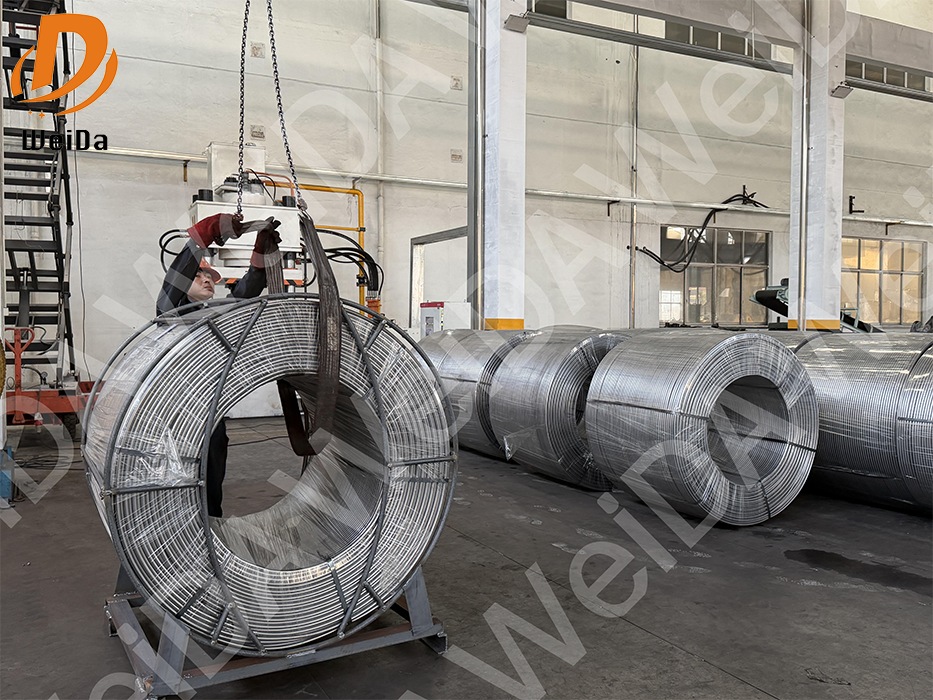
Second, adjust the MgO saturation in the slag. The main component of ladle refractories is MgO (magnesia). When the MgO content in the refining slag approaches or reaches saturation, the slag's ability to dissolve MgO refractories is greatly reduced. Wuxi WeiDa provides magnesia cored wire (MgO cored wire) to precisely supplement MgO into the slag, bringing it to or near saturation, thereby significantly slowing the corrosion of the ladle wall by the slag. Research shows that increasing MgO content in the slag from 5% to 8-10% can extend ladle life by 30-50%.
Third, optimize slag basicity and viscosity. Slag with excessively high basicity has poor fluidity but strong corrosiveness; excessively low basicity results in weak desulfurization capability. Wuxi WeiDa's expert team will recommend the optimal slag basicity range (typically between 3-5 for basic ladles) based on your steel grade and refining process. Simultaneously, adding appropriate amounts of Al₂O₃ or MgO adjusts slag viscosity, allowing it to effectively desulfurize without causing excessive of the refractories.
Fourth, reduce temperature fluctuations. Severe temperature changes are a major cause of refractory spalling. Using our ladle covering fluxes and insulating cored wires reduces temperature drop during refining and transport, thereby reducing thermal shock damage to the ladle refractories.
One Ladle for Multiple Heats: A Win-Win for Economics and Quality
Reducing refractory consumption brings not only direct cost savings. Longer ladle life means fewer ladle turns, lower accident risk, and higher production efficiency. After implementing Wuxi WeiDa's slag system optimization, many customers have successfully achieved a 30% or more extension in ladle life, along with a significant reduction in total inclusion content in the steel, as impurities from refractory spalling are minimized.
If you are troubled by high refractory consumption in steel ladles and wish to achieve longer ladle life and higher steel cleanliness, please visit https://www.weidamaterials.com/ to obtain information on our professional services for refining slag design and ladle protection.