

Following our discussion on ladle refractory protection, we return to a topic mentioned in previous articles but extremely sensitive for quality: homogeneity control in boron-treated steels. Boron is one of the most cost-effective elements for improving steel hardenability, but it also has the strongest "temperament": the effective concentration window for boron is extremely narrow (0.0005%-0.003%), and uneven distribution can lead to local hardness variations, hardenability fluctuations, and even grain boundary embrittlement. For products like automotive gears, high-strength fasteners, and spring steels, uniform boron distribution is key to ensuring performance consistency. How can you ensure homogeneous distribution of boron in molten steel and prevent its deactivation by reaction with nitrogen and oxygen? Wuxi WeiDa Cored Wire Co.,Ltd provides boron distribution control solutions based on composite cored wire technology and process synergy.
The Challenge of Boron Uniformity: Microscopic Distribution Determines Macroscopic Properties
Boron's behavior in steel is extremely. First, its effective concentration window is extremely narrow: below 0.0005%, the effect is unconspicuous; above 0.003%, it forms Fe₂B or FeB borides that precipitate along grain boundaries, causing boron embrittlement. Second, boron readily reacts with nitrogen and oxygen to form BN and B₂O₃, which have no hardenability-enhancing effect whatsoever. Third, boron has a strong segregation tendency in molten steel; if added improperly or inadequately stirred, it leads to locally high or low boron concentrations. Ultimately, these microscopic inhomogeneities manifest as: large hardenability variations between different slabs from the same heat, inconsistent hardness at different locations on the same forging, and large heat treatment distortion.
Our Solution: Composite Protection and Precise Addition
The core of Wuxi WeiDa's boron treatment solution is "protect, protect, protect again" – ensuring boron exists as free atoms and is uniformly distributed.
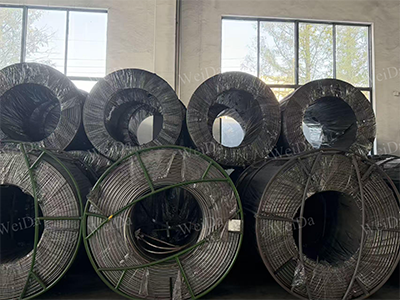
First, use boron-titanium composite cored wire. This is the most reliable method for protecting boron. Titanium has a much stronger affinity for nitrogen than boron does; adding titanium first "fixes" the free nitrogen in the steel, forming stable TiN, thereby preventing boron from being "kidnapped" by nitrogen. Our boron-titanium cored wire encapsulates boron and titanium in optimized ratios (typically Ti/N > 4) within a single wire, accomplishing protection and addition in one step.
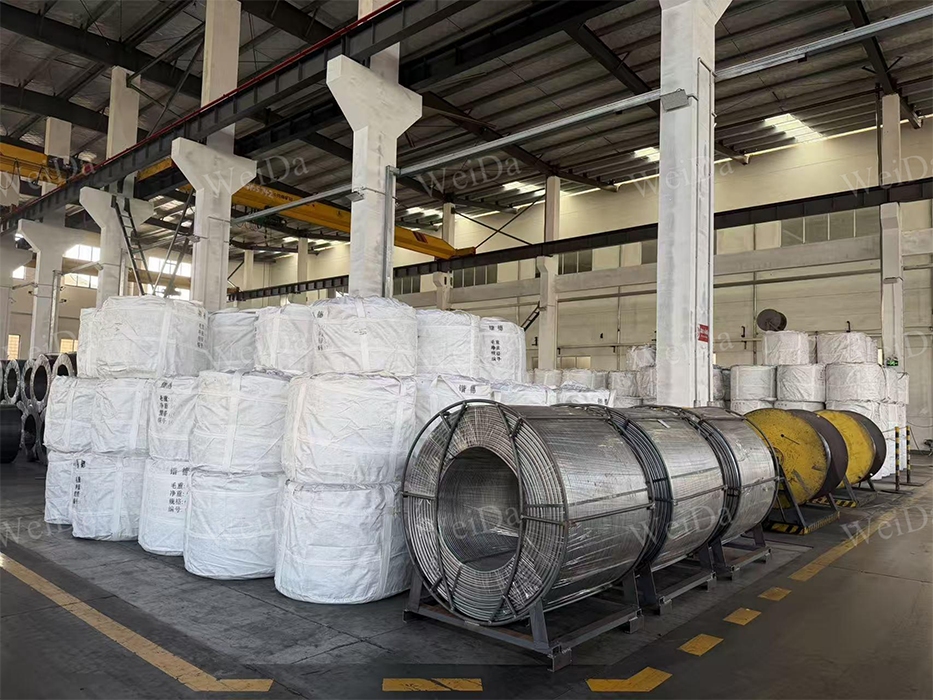
Second, use boron-aluminum composite cored wire. For steel grades that have already undergone thorough aluminum deoxidation, boron-aluminum cored wire can be used. Aluminum is also a strong deoxidizer, further reducing free oxygen in the steel, creating a safe "living environment" for boron. This solution is suitable for high-quality boron steels with extremely strict oxygen content control.
Third, optimize feeding position and stirring parameters. Boron addition must occur after deoxidation and denitrogenation are fully completed. We recommend adding boron during the late refining stage, during composition fine-tuning. After feeding the wire, moderate, short-duration argon stirring (typically 1-2 minutes) is necessary to ensure uniform boron distribution. Excessively strong stirring causes boron to float up into the slag and become oxidized; overly weak stirring fails to achieve homogenization.
Fourth, control nitrogen content in the steel. As mentioned, nitrogen is the "natural enemy" of boron. By using low-nitrogen alloys and protective casting, keeping nitrogen content in the steel below 60ppm maximizes the effective utilization rate of boron. For steel grades with inherently high nitrogen conditions, titanium must be used for "pre-protection."
Process Synergy: Integrated Control from Refining to Casting
Ensuring boron uniformity cannot rely solely on the addition step; it also requires from upstream and downstream processes:
•Deoxidation control: Before adding boron, ensure the steel is fully deoxidized. Use aluminum wire for final deoxidation, controlling dissolved oxygen below 5ppm.
•Continuous casting protection: Full protective casting from tundish to mold prevents secondary oxidation and nitrogen absorption, avoiding boron "consumption" during solidification.
•Appropriate casting temperature: Appropriately reducing steel superheat can reduce boron segregation during solidification.
The Value of Boron Treatment: Creating Major Benefits with Trace Amounts
Boron is the most cost-effective hardenability element. The hardenability improvement from 0.001% boron (10ppm) is equivalent to 0.5% manganese, 0.3% chromium, or 0.1% molybdenum. Therefore, even though boron is relatively expensive, considering the extremely small, its overall cost is far lower than traditional alloy addition methods. But the for all this is: boron must be effectively and uniformly utilized. Otherwise, the added boron is either wasted (turning into BN) or becomes harmful borides.
Wuxi WeiDa's boron treatment technology has helped numerous gear steel and fastener steel producers achieve hardenability bandwidths controlled within 4 HRC, significantly improving product batch stability and customer satisfaction.
If you are producing boron-treated steels and wish to achieve narrower hardenability bandwidths and eliminate boron embrittlement risks, please visit https://www.weidamaterials.com/ to obtain our professional guidance on boron microalloying process optimization.