

Following our previous discussion on homogeneous boron distribution in boron-treated steels, which highlighted the critical impact of precise trace element addition on properties, today we focus on another steel grade highly sensitive to inclusion control: titanium-stabilized stainless steels (such as 321, Ti-409, etc.). To prevent intergranular corrosion, titanium (Ti) is added to these grades to fix carbon and nitrogen. However, titanium addition brings a troublesome continuous casting problem: nozzle clogging. Titanium reacts with oxygen and nitrogen in the molten steel to form high-melting-point TiN and TiOx inclusions, which readily accumulate on the inner wall of the nozzle, leading to casting interruptions. How can you prevent nozzle clogging during continuous casting of titanium-stabilized stainless steels and achieve stable, multi-heat continuous casting? Wuxi WeiDa Cored Wire Co.,Ltd provides specialized solutions based on titanium addition process optimization and composite deoxidation.
The "Culprits" of Clogging in Titanium-Stabilized Stainless Steels: TiN and TiOx
In titanium-containing stainless steels like 321, the primary purpose of titanium addition is to react with carbon and nitrogen, preventing the precipitation of Cr23C6 that causes intergranular corrosion. However, titanium is an extremely strong oxide and nitride former. At molten steel temperatures, titanium reacts with dissolved oxygen and nitrogen in the steel to form TiOx (titanium oxides) and TiN (titanium nitride) . These two compounds have the following characteristics:
•Extremely high melting points: The melting point of TiN is approximately 2950°C, and that of TiOx ranges from 1700-2000°C. They remain solid at molten steel temperatures.
•Sharp morphology: TiN and TiOx typically exhibit cubic or polyhedral shapes with sharp edges, making them highly prone to adhering to the refractory surface of the nozzle.
•Difficult to float: Due to their fine size (typically 1-10 microns), they are difficult to remove by flotation in the molten steel.
When these inclusions are present in large quantities in the molten steel, they continuously abrade and accumulate on the nozzle inner wall like "sandpaper," eventually causing complete clogging.
Our Solution: From Source Control to Process Intervention
Wuxi WeiDa has developed a complete anti-clogging strategy tailored to the characteristics of titanium-stabilized stainless steels.
First, rigorous deoxidation pretreatment. Before adding titanium, the dissolved oxygen in the molten steel must be reduced to extremely low levels. We recommend using aluminum wire for deep deoxidation, controlling oxygen content below 20ppm. At the same time, use calcium silicon wire to further reduce oxygen activity and modify Al₂O₃ inclusions. The core objective of this step is: minimize free oxygen in the molten steel before adding titanium.
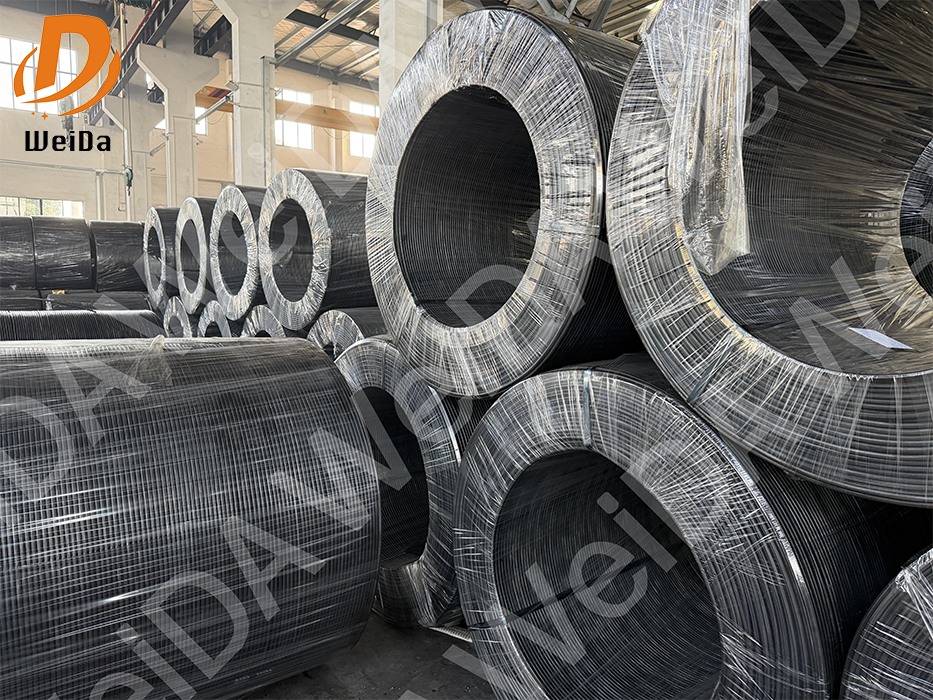
Second, precise control of titanium addition amount and timing. More titanium is not necessarily better. Excess titanium generates more TiN/TiOx, exacerbating the clogging risk. We recommend a "small, multiple additions" strategy, using ferro titanium cored wire to precisely add titanium deep into the molten steel. The timing should be after deoxidation is complete and before casting begins, allowing sufficient time for already-formed TiN/TiOx to float up and be removed.
Third, optimize calcium treatment strategy. For titanium-stabilized stainless steels, conventional calcium treatment must be used cautiously. Calcium competes with titanium for reactions and may form CaS or Ca-Ti-O complex compounds. Our technical team will develop a customized calcium treatment plan based on the specific steel grade composition – either avoiding calcium treatment entirely or employing "micro-calcium treatment" solely to modify Al₂O₃ without interfering with titanium.
Fourth, optimized mold flux selection. For titanium-stabilized stainless steels, mold fluxes with low reactivity and high absorption capacity are needed. The SiO₂ in ordinary mold fluxes can react with titanium in the molten steel, generating titanium oxides and increasing the inclusion load. We recommend using specialized mold fluxes with high basicity and low SiO₂ that have the ability to rapidly absorb TiN/TiOx.
Fifth, enhanced tundish metallurgy. By optimizing the tundish flow field design (weirs, dams), the residence time of molten steel in the tundish is extended, promoting the collision, growth, and flotation of fine TiN/TiOx inclusions. Simultaneously, use argon sealing and submerged entry nozzles to prevent secondary oxidation of the molten steel and the generation of new titanium oxides.
The Synergistic Effect of Processes
Solving the nozzle clogging problem for titanium-stabilized stainless steels has no "silver bullet." It requires the coordinated cooperation of multiple steps: deoxidation → calcium treatment → titanium addition → mold flux → tundish metallurgy. Wuxi WeiDa's strength lies in our deep understanding of each step and the mature product support we provide. Our technical team can conduct a full-process audit for you, identifying the bottleneck steps restricting your casting performance and providing targeted improvement plans.
If you are producing titanium-containing stainless steels (321, 409, 441, etc.) and have long been troubled by nozzle clogging and low sequence casting heats, please visit https://www.weidamaterials.com/ to obtain our specialized solution for continuous casting technology of titanium-stabilized stainless steels.