

Following our discussion on continuous casting challenges of titanium-stabilized stainless steels, we turn our attention to one of the smallest steel products yet with the most demanding cleanliness requirements: tire cord steel. Tire cord steel is used to produce steel cord for automobile tires, with final diameters as fine as 0.15-0.38 mm. At this scale, an inclusion of just 10 microns in diameter can be the "culprit" causing wire breakage during drawing. For tire cord steel producers, non-metallic inclusion control is the lifeline determining product quality and economic efficiency. How can you systematically control non-metallic inclusions in tire cord steel to achieve ultra-high cleanliness and meet the stringent drawing requirements of the tire industry? Wuxi WeiDa Cored Wire Co.,Ltd provides a full-process inclusion engineering solution from steelmaking to continuous casting.
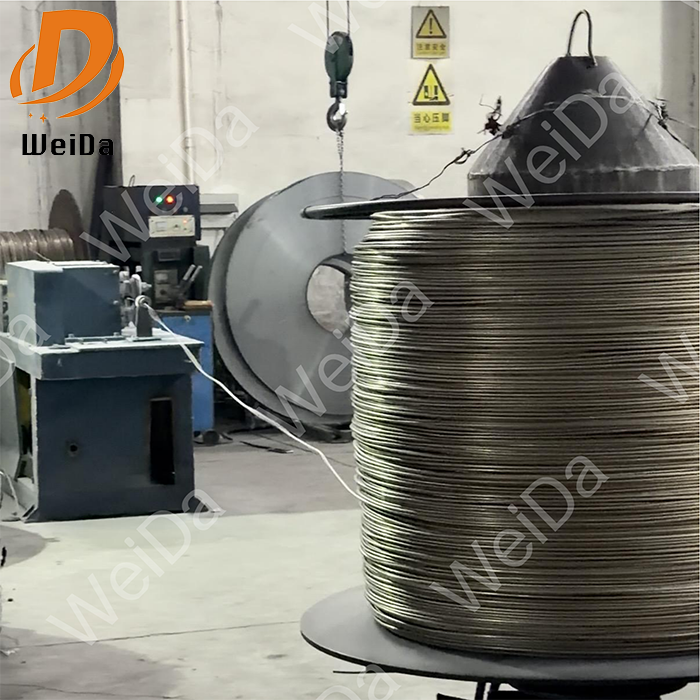
The "Zero Tolerance" Requirement for Tire Cord Steel: From Microscopic Inclusions to Macroscopic Wire Breaks
Tire cord steel is a high-carbon steel (carbon content 0.70%-0.82%) whose final product is steel wire thinner than a human hair. During drawing, any inclusion larger than 2% of the wire diameter can cause wire breakage. For a wire with a diameter of 0.20mm, an inclusion of just 4 microns is sufficient to cause breakage. The most harmful inclusion types in tire cord steel include:
•Hard, brittle inclusions: Such as Al₂O₃, spinel (MgO·Al₂O₃), TiN, etc. These inclusions do not deform during drawing and directly cut the steel wire matrix.
•Large inclusions: Any inclusion exceeding 10-15 microns in size, regardless of its composition, can become a fracture source.
•Non-deformable inclusions: Products of calcium treatment such as CaO and CaS can also be harmful if not properly controlled.
Our Solution: The Perfect Combination of Composition Design and Process Control
Wuxi WeiDa has developed a mature inclusion control system for tire cord steel production.
First, low-melting-point design. The ideal inclusions for tire cord steel should have low melting points and high deformability. Research indicates that the low-melting-point region (melting point <1200°C) in the SiO₂-MnO-Al₂O₃ ternary system is the target composition range for tire cord steel inclusions. We achieve this by avoiding aluminum deoxidation (or using extremely aluminum) and instead using silicon-manganese composite deoxidation, promoting inclusions toward the low-melting-point region of the MnO-SiO₂-Al₂O₃ system. Our silicon-manganese cored wire is precisely designed for this purpose, enabling precise control of the deoxidation product composition in the molten steel.
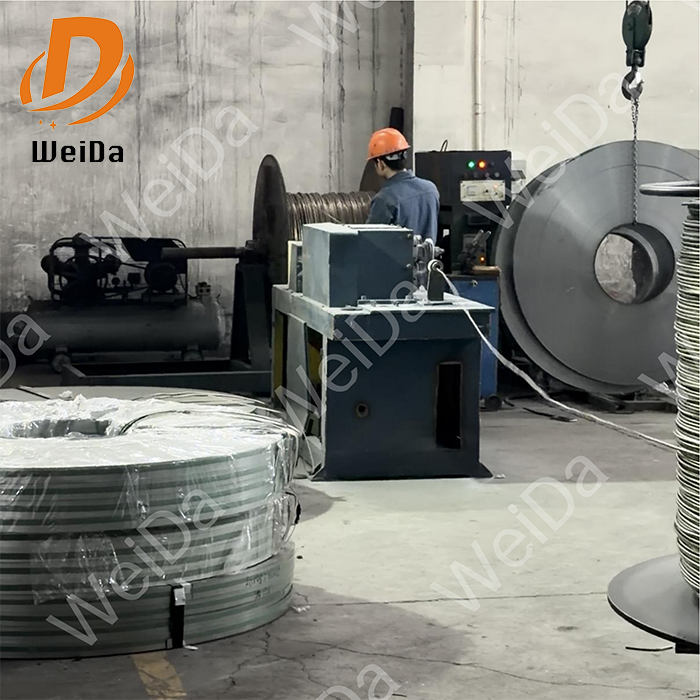
Second, avoid calcium treatment. Unlike most steel grades, tire cord steel should avoid calcium treatment. Calcium reacts with sulfur and aluminum in the molten steel to form high-melting-point CaS and CaO-Al₂O₃-based inclusions, which do not deform during drawing and are extremely harmful. Wuxi WeiDa recommends a "calcium-free" process route for tire cord steel, controlling inclusions solely through silicon-manganese deoxidation and refining slag absorption.
Third, optimize the refining slag system. The refining slag for tire cord steel should have high basicity, low Al₂O₃, and low FeO. Our synthetic slag cored wire helps rapidly form this ideal refining slag, efficiently absorbing deoxidation products from the molten steel and preventing Al₂O₃ from "re-dissolving" from the slag back into the steel.
Fourth, strictly control titanium content. Titanium is one of the most harmful impurity elements in tire cord steel because TiN has extremely high hardness and a sharp morphology. We recommend controlling titanium content in the steel below 0.001%. To this end, we provide high-quality alloys such as low-titanium high-purity ferrosilicon and low-titanium ferromanganese, added via cored wire to avoid titanium contamination.
Fifth, protect the continuous casting process. Tire cord steel is extremely sensitive to secondary oxidation. Full protective casting must be employed, including ladle long nozzle argon sealing, tundish covering flux, and submerged entry nozzles. Any air contact will generate Al₂O₃ inclusions, the composition control of low-melting-point inclusions.
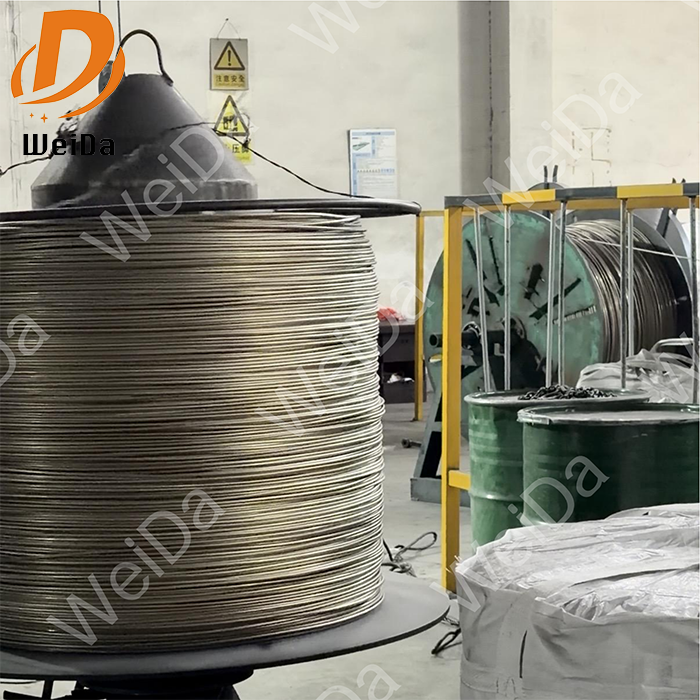
From Raw Materials to Finished Product: A Systematic Engineering Success
Producing high-quality tire cord steel is a systematic engineering task. Every step matters, from raw material selection and smelting processes to refining slag systems and continuous casting protection. Wuxi WeiDa not only provides tire cord steel-specific products such as silicon-manganese cored wire, synthetic slag cored wire, and low-titanium alloy cored wire, but also offers process consulting services covering the entire process flow. Our technical team has helped numerous tire cord steel producers achieve wire breakage rate reductions of over 50% .
If you are producing or wish to develop high-quality tire cord steel and challenge 0.15mm ultra-fine specifications, please visit https://www.weidamaterials.com/ to obtain our technical white paper on inclusion control for tire cord steel.