

In the previous article, we discussed calcium treatment optimization for low-carbon aluminum killed steel. Today, we focus on an area with exceptionally demanding steel cleanliness requirements: high-performance bearing steel. Bearing steel is subjected to extremely high contact stresses during service. Any tiny non-metallic inclusion can become a crack source for fatigue spalling. For high-fatigue-life bearing steel, controlling only "large" inclusions is insufficient – microscopic inclusions even at the micron or sub-micron level are equally critical. How can you systematically control microinclusions in bearing steel to achieve ultra-high cleanliness and meet the stringent service requirements of high-end bearings? Wuxi WeiDa Cored Wire Co.,Ltd provides a comprehensive solution based on full-process inclusion engineering.
Microinclusions: The "Invisible Killer" of Bearing Steel Fatigue Life
Fatigue failure in bearing steels (such as GCr15, 100Cr6) typically initiates at the interface between internal inclusions and the steel matrix. Traditionally, only inclusions larger than 10-15 microns were considered harmful. However, recent research shows that under very high cycle fatigue (10^8-10^9 cycles) conditions, inclusions as small as 3-5 microns can also become crack sources. The main types of these microinclusions include:
•Brittle oxides: Such as Al₂O₃, MgO·Al₂O₃ (magnesium aluminate spinel), and CaO·Al₂O₃ systems.
•Nitrides: Such as TiN, which is extremely harmful due to its very high hardness and sharp edges.
•Non-deformable sulfides: Such as CaS, which does not deform during processing and similarly disrupts matrix continuity.
Sources of Microinclusions
Unlike slab surface defects, microinclusions in bearing steel are not from exogenous contamination (e.g., mold flux, refractories), but are endogenous inclusions. Their sources include:
•Deoxidation products: Al₂O₃ generated from aluminum deoxidation and complex oxides formed from its reaction with MgO and CaO in the slag.
•Impurities in alloys: TiN formed from reactions of elements like titanium and nitrogen introduced from ferroalloys.
•Secondary oxidation products: Oxides generated when molten steel contacts air during casting.
Our Solution: Source Control and Pathway Interruption
Wuxi WeiDa has developed a full-process microinclusion control strategy for high-performance bearing steel.
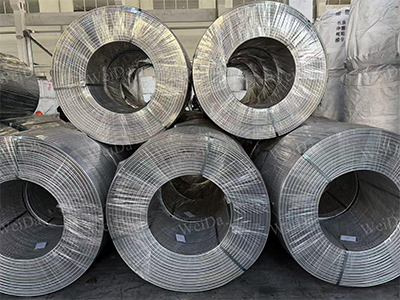
First, select high-quality alloy raw materials with low titanium and low aluminum. Titanium is one of the most harmful impurities in bearing steel. TiN inclusions are far more damaging to fatigue life than Al₂O₃. We provide high-quality alloys such as low-titanium high-purity aluminum wire, low-titanium ferrosilicon, and low-titanium ferromanganese, added via cored wire, to control titanium introduction at the source. Recommended target: control final product titanium content below 0.0015% .
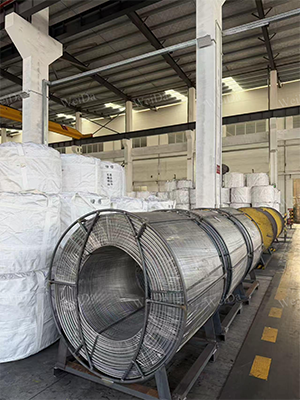
Second, optimize the deoxidation process to avoid forming hard and brittle inclusions. The Al₂O₃ generated from traditional aluminum deoxidation should be modified into low-melting-point calcium aluminates through calcium treatment. However, calcium treatment must be "precisely applied" to avoid forming high-melting-point CaO·2Al₂O₃ or 3CaO·Al₂O₃. Our precision calcium treatment technology can control the Ca/Al ratio within the optimal window (Ca/Al = 0.08-0.15), completely transforming inclusions into liquid 12CaO·7Al₂O₃. This type of inclusion is liquid at molten steel temperatures, easily floats up, and has minimal impact on properties.
Third, control the MgO content in the slag to inhibit magnesium aluminate spinel formation. Magnesium aluminate spinel (MgO·Al₂O₃) is a hard and brittle inclusion, as harmful as Al₂O₃. When the MgO content in the refining slag is too high, Mg from the slag reacts with Al and O in the steel to form spinel. We recommend controlling MgO content in the slag at 5-8% and making precise adjustments using magnesia cored wire to prevent MgO oversaturation.
Fourth, strictly control titanium and nitrogen content in the steel. TiN formation requires both titanium and nitrogen. In addition to controlling the source of titanium, nitrogen content in the steel should be kept below 50ppm through protective casting and low-nitrogen alloys. If the simultaneous presence of titanium and nitrogen is unavoidable, rare earth treatment can be considered to modify the TiN, enveloping its surface with rare earths to reduce its harmfulness.
Fifth, enhance tundish metallurgy to promote flotation of microinclusions. For microinclusions below 5 microns, the Stokes flotation velocity is extremely slow. We recommend using tundish channel induction heating or gas curtain dam technology to generate fine bubbles. These bubbles capture microinclusions through a "flotation" effect, promoting their removal. At the same time, optimize the tundish flow field to avoid short-circuiting flow.
The Leap from "Adequate" to "Premium"
Producing top-tier bearing steel requires controlling the size, number, morphology, and composition of inclusions within very narrow ranges. Wuxi WeiDa's full-process inclusion engineering solution has helped numerous bearing steel producers achieve stable control of oxygen content below 5ppm, TiN inclusion rating of 0, and more than double the fatigue life.
If you are challenging the production of high-end bearing steel and aiming for internationally advanced cleanliness standards, please visit https://www.weidamaterials.com/ to obtain our technical white paper on microinclusion control for bearing steel.