

In the previous article, we discussed how to improve the internal quality of large forging ingots, mentioning the important impact of deoxidation products on ingot quality. Today, we return to the most fundamental step in molten steel refining: deoxidation practice. Deoxidation is a necessary process for almost all steel grades, but its quality determines the effectiveness of all subsequent refining measures. Insufficient deoxidation leads to alloy burn-off and increased inclusions. Excessive deoxidation wastes deoxidizer and generates large quantities of Al₂O₃ inclusions. How can you find the "optimal balance point" in deoxidation practice to ensure fully killed steel while minimizing the quantity and size of deoxidation products? Wuxi WeiDa Cored Wire Co.,Ltd provides a comprehensive solution based on precision deoxidizer addition and composite deoxidation technology.
The Core Contradiction of Deoxidation: "Sufficiently Killed" vs. "Not Overdone"
The essence of deoxidation is to reduce dissolved oxygen in molten steel to a level in equilibrium with alloying elements. With insufficient deoxidation, residual oxygen reacts with alloys such as titanium and boron, causing recovery fluctuations and forming bubbles and oxide defects. With excessive deoxidation, excess aluminum generates large quantities of Al₂O₃ inclusions, becoming the source of nozzle clogging and product defects. The traditional single-batch aluminum addition method has unstable recovery (60-90%), non-uniform reaction, and cannot be adjusted online, making it difficult to achieve "just right."
Our Solution: Precision Aluminum Feeding and Composite Deoxidation
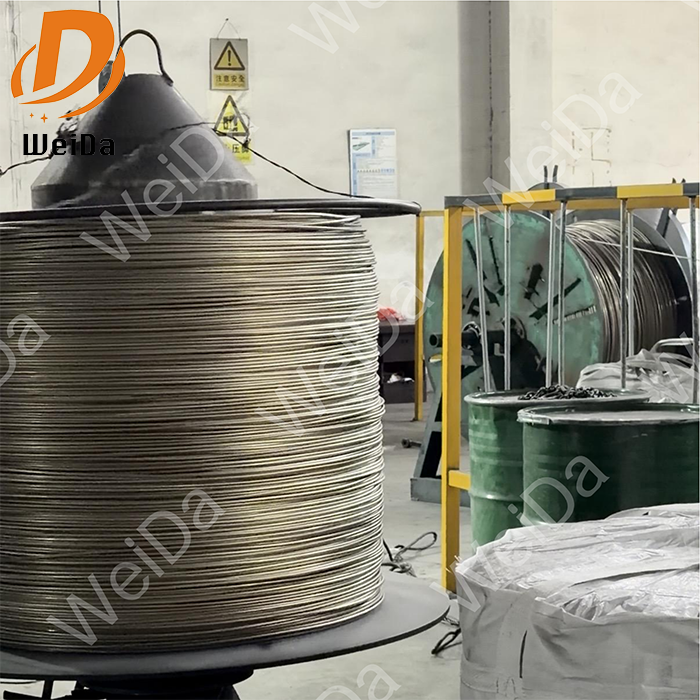
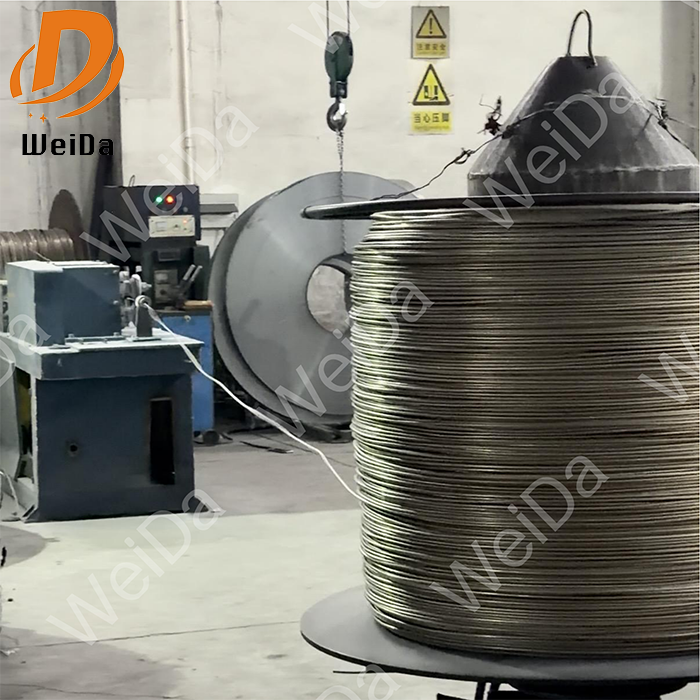
First, use high-purity aluminum wire for precision aluminum feeding. Our high-purity aluminum cored wire encapsulates 99.7%+ high-purity aluminum powder in a steel sheath and is injected deep into the molten steel via a wire feeder. Compared to single-batch addition of aluminum lumps, aluminum wire feeding offers significant advantages: stable recovery of 90-95% , uniform concentration, and online adjustment based on oxygen activity.
Second, adopt composite deoxidation technology. Single aluminum deoxidation produces clustered Al₂O₃ that is difficult to remove. We recommend using composite deoxidizer cored wires such as calcium silicon barium wire and aluminum calcium wire, where elements like calcium and barium modify Al₂O₃ to form low-melting-point composite inclusions that easily agglomerate and float up. A stepwise strategy of silicon manganese pre-deoxidation followed by aluminum final deoxidation further reduces the total amount of Al₂O₃ generated.
Third, implement real-time oxygen activity monitoring for closed-loop control. Use solid electrolyte oxygen probes to measure oxygen activity in real-time. Based on the measured value, dissolved oxygen content is calculated to determine whether additional aluminum wire is needed. This "measure-calculate-feed" closed-loop mode upgrades deoxidation from experience-based to data-driven precision control.
Fourth, optimize the removal pathway of deoxidation products. We recommend 8-15 minutes of argon soft stirring after deoxidation to promote inclusion collision and flotation; use high-basicity, low-FeO refining slag to ensure inclusions are absorbed by the slag; and provide 10-20 minutes of holding time after refining to allow residual fine inclusions to further float up.
Comprehensive Optimization of Process Parameters
Taking low-carbon aluminum killed steel as an example, the recommended plan includes: adding silicon manganese for pre-deoxidation during tapping, measuring oxygen activity upon LF arrival and calculating aluminum wire feed length (target residual aluminum 0.020-0.040%), soft stirring for 12 minutes after wire feeding, and holding for 15 minutes after refining. After implementation, total oxygen content was reduced from 25-35ppm to 12-18ppm, and the Al₂O₃ inclusion rating was reduced from 2.0 to 1.0.
From "Rough Deoxidation" to "Precision Deoxidation"
Wuxi WeiDa's precision deoxidation solution frees you from the rough practice of "adding aluminum by feel" and ushers you into a new era of data-driven, precision-controlled deoxidation. Through the combination of precision aluminum wire feeding, synergistic composite deoxidation, and real-time oxygen activity monitoring, you can achieve lower oxygen content, fewer inclusions, and more stable quality.
If you are troubled by high oxygen content in steel, excessive inclusions, or excessively high aluminum consumption costs, please visit our website https://www.weidamaterials.com/ to obtain the complete solution for deoxidation practice optimization and steel cleanliness improvement.